



Your weekly slice of Historical Poetry
> Walt Whitman
> Matthew Arnold
> George MacDonald
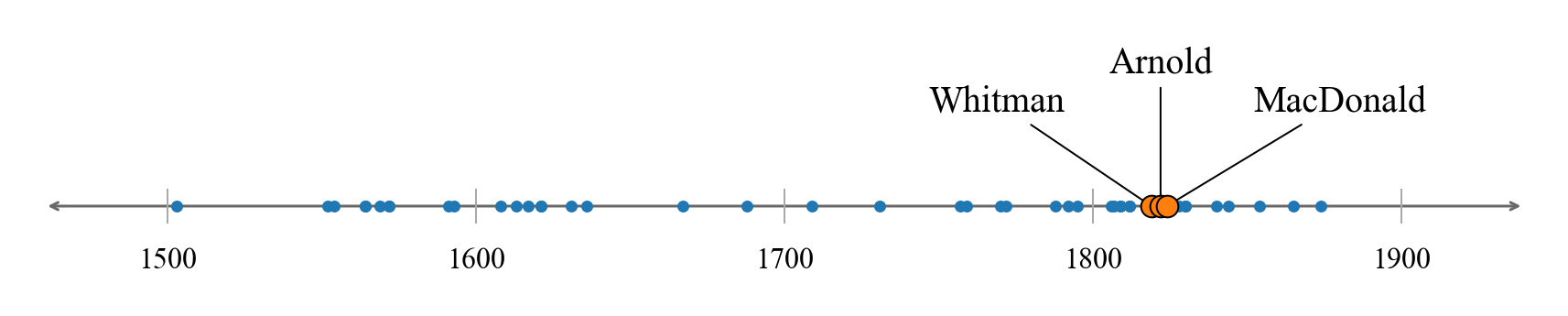
Welcome to part 17 of the Poets of History! Apologies for the lateness of this edition; life has been extremely full these last few weeks, requiring me to delay the release of this post (and likely the next scheduled one as well). Regardless, this week covers three poets of the 19th century, all fairly different from each other in their styles and perspectives. I hope you enjoy!
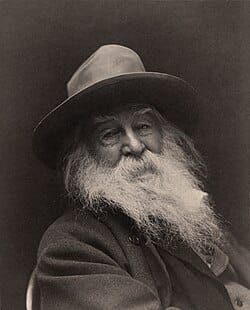
Walt Whitman
1819-1892
Walt Whitman was an American poet and author, considered by many to be the father of free verse poetry. He did not, of course, invent free verse, nor did he write exclusively in it; yet his style was so unusual that he was not very well received at the time. He represents, however, something that was growing in America at that time, a spirit of individuality, subjectivism, and transcendentalism. His most famous volume was a book of poems, called "Leaves of Grass," that he revised unceasingly through his life (even on his deathbed!). He contributed to patriotic poetry as well, best represented in the poem below.
O Captain! My Captain!
This is one of the best known poems written for an American president, penned after the assassination of Abraham Lincoln. It depicts a ship coming into port, completing a long and arduous journey. Amid the bells and joy of the homecoming, however, the captain lies dying on the deck. The one who had gotten the ship safely back could not enjoy the peace home. "Fallen, cold and dead" rings at the end of each stanza, paralleling the joyous ringing of the bells.
This is not free verse by any means. It is composed of three stanzas of eight lines. The first four lines are written in iambic heptameter (7 feet) with a tag (an extra unstressed syllable at the end of the line). Heptameter lines have something of a ballad flow to them, since they are typically broken into a 4-3 structure. It makes sense, then, that the last four lines of each stanza are a proper ballad verse structure, with lines of length 4-3-4-3.
Further Reading
- The Great City - A free verse, or "prose poem," on what makes a city truly great.
- Leaves of Grass - Here is an archive of each (of the many) editions that Whitman made to his most famous volume of poetry, "Leaves of Grass."
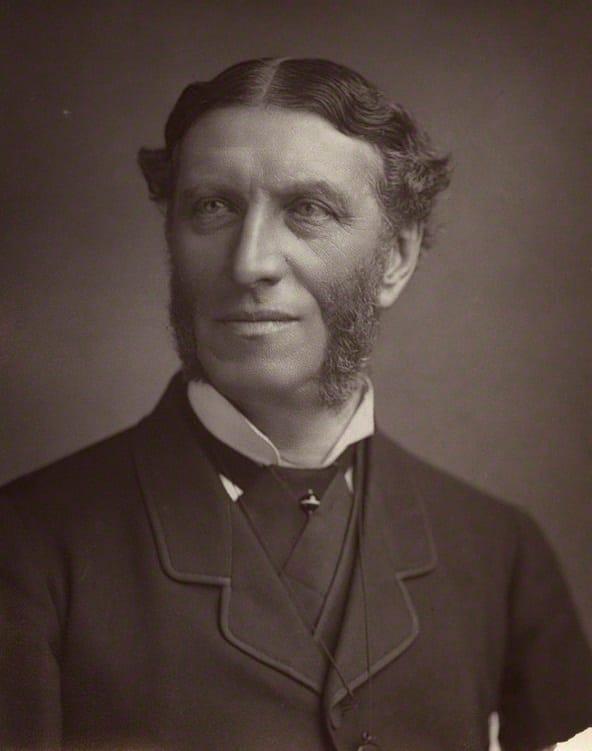
Matthew Arnold
1822-1888
Matthew Arnold was an English poet and critic of the Victorian era. His poems seems to lean more often on the side of the intellect, reason, and somberness, rather than religion, fancy, and cheerfulness. They are, nonetheless, very poignant, thought-provoking, and effective. They are generally clear, containing an idea or thought that is intended to be perceived and considered. In other words, while the thoughts may be complex (and require repeated readings), they are not mysterious or indiscernible.
The Buried Life
This poem made quite an impression on me when I first read it. Written over 150 years ago, it describes so much of where our world is now and how empty it can all feel. It is expected that "we can jest" and "we can smile" (line 4-5), but there is still a "nameless sadness" that remains. We put on fronts and hide the truths that are deep in our hearts. The poem carries this line of thought for most of the poem, until the end when there is a beautiful turn, starting with the line "Only—but this is rare—". It is worth reading in its entirety to feel the satisfaction of the end.
It is mostly written in rhyming couplets (AABB...), though he does sometimes stagger the rhymes in an alternating fashion (ABAB...). He also allows himself to vary the line lengths here and there, though they are mostly in iambic tetrameter. Overall, the poem flows well as a lucid discourse on society and mankind.
Further Reading
- Dover Beach - A sea-side poem, though one where, interestingly, the lulling sea brings more thoughts of somber melancholy than rest. It presents a world that is unenchanted and raw. The only salvation is for us to love, to "be true / To one another", in contrast with a uncaring world.
- To Marguerite - Similar to "Dover Beach," a melancholy impression of the uncrossable seas that separate each of us individually.
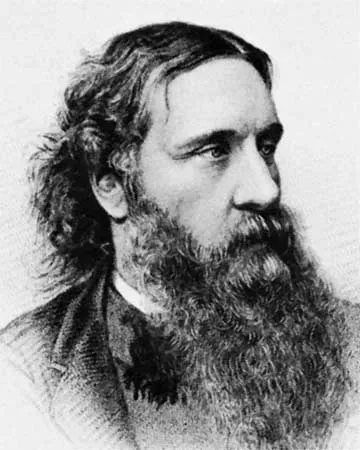
George MacDonald
1824-1905
George MacDonald was a Scottish author and Christian minister, best known for writing fantasy novels (such as Phantastes), poetry, and fairy tales. His style of fantasy is said to be a precursor for much of the fantasy stories to be written in the coming generations, influencing such people as C.S. Lewis and J.R.R. Tolkien. His writing has a closeness to children, seen in his children's poems and fairy tales. We see in him the firm thread that good literature is that which can be enjoyed by both children and adults, a sentiment felt very clearly in the Inklings and other authors of that variety.
I Know What Beauty Is
This poem is well written in both its statement and its music. Each stanza presents various aspect of Creation that are good, things within which beauty can be found. Rather than merely being a list of good things, this poem turns in the last three stanzas to something much truer of the universe. All beauty is but a necklace around Christ, the true source of all glory and grace.
The poem is written in quatrain stanzas of iambic tetrameter with an ABBA rhyming scheme. The music of the final stanza floored me when I read it the first time, accentuating the dramatic turn of the poem itself.
...I lose to find. On fair-browed bride
Fair pearls their fairest light afford;
So, gathered round thy glory, Lord,
All glory else is glorified.
The first two lines have the repetition of "fair" and other f sounds. The last two lines contain repetitions of "glory," with other accenting g and or sounds. Such an ending is worthy of his own description of verse in stanza 5:
And verse I know, whose concord high
Of thought and music lifts the soul...
Sweet Peril
This poem was comforting recently during a time of tension and stress in our life. The first line is so simple and clear, yet such an honest expression that anyone can resonate with.
Alas, how easily things go wrong!
The poem continues this thought through the first two stanzas, describing those things that never seem to last as long as we'd like. Yet, upon the third stanza we find the turn, where things can turn right just as easily as they turned sour. There is a reversal of those images of the first two stanzas until we end in the sunshine where we always wished to be.
The poem is structured in an interesting, almost chiastic way. Stanzas 1 and 4 have mirroring rhymes (-ong and -ain), as do stanzas 2 and 3 (-ite and -ay). Stanzas 1/4 consider things going wrong, rain and love. Stanzas 2/3 consider things going right, summer nights and winter days. This going away and coming home again is comforting. It may be true that "life is never the same again," but it is also true that there will be "sunshine again."
Further Reading
- That Holy Thing - This is a well-known poem often shared during Christmas time.
- Bedtime - This is a great children's/family poem, on the tall task of getting the kids to bed.
Exile
Abram Newcomer
This poem sprang up in my mind during Sunday School a few months ago. The theme of exile (just like all other themes in the Bible) can be traced through many different contexts through Scripture, all the way into our own lives. There is a shock in finding that we are not only not exiled from Christ's kingdom, but that our sin itself is exiled from us. The poem's form takes its cues from Herbert's Virtue, in which a pattern is established ("sent out from the land") for 3 stanzas and then flipped in the final line.
Thank you for your patience and I hope you have a good rest of your week!
Discussion