



Your weekly slice of Historical Poetry
> Edgar Allan Poe
> Alfred, Lord Tennyson
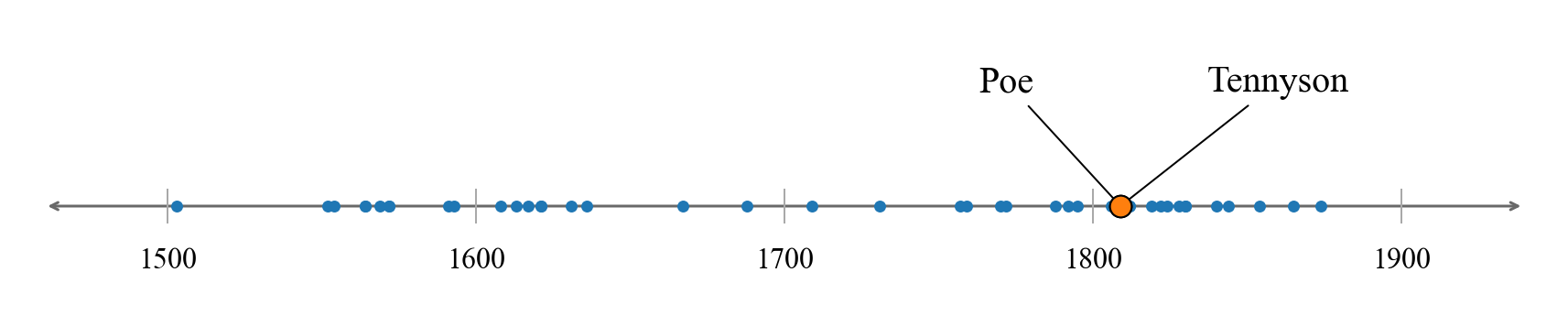
This week of The Poets of History has the honor of featuring two of my favorite poets, one American and one English. Both Poe and Tennyson are masters of sound and rhythm in ways that have cemented them as greats in the history of poetry. Your ears are in for a treat with today's selections. I hope you enjoy!
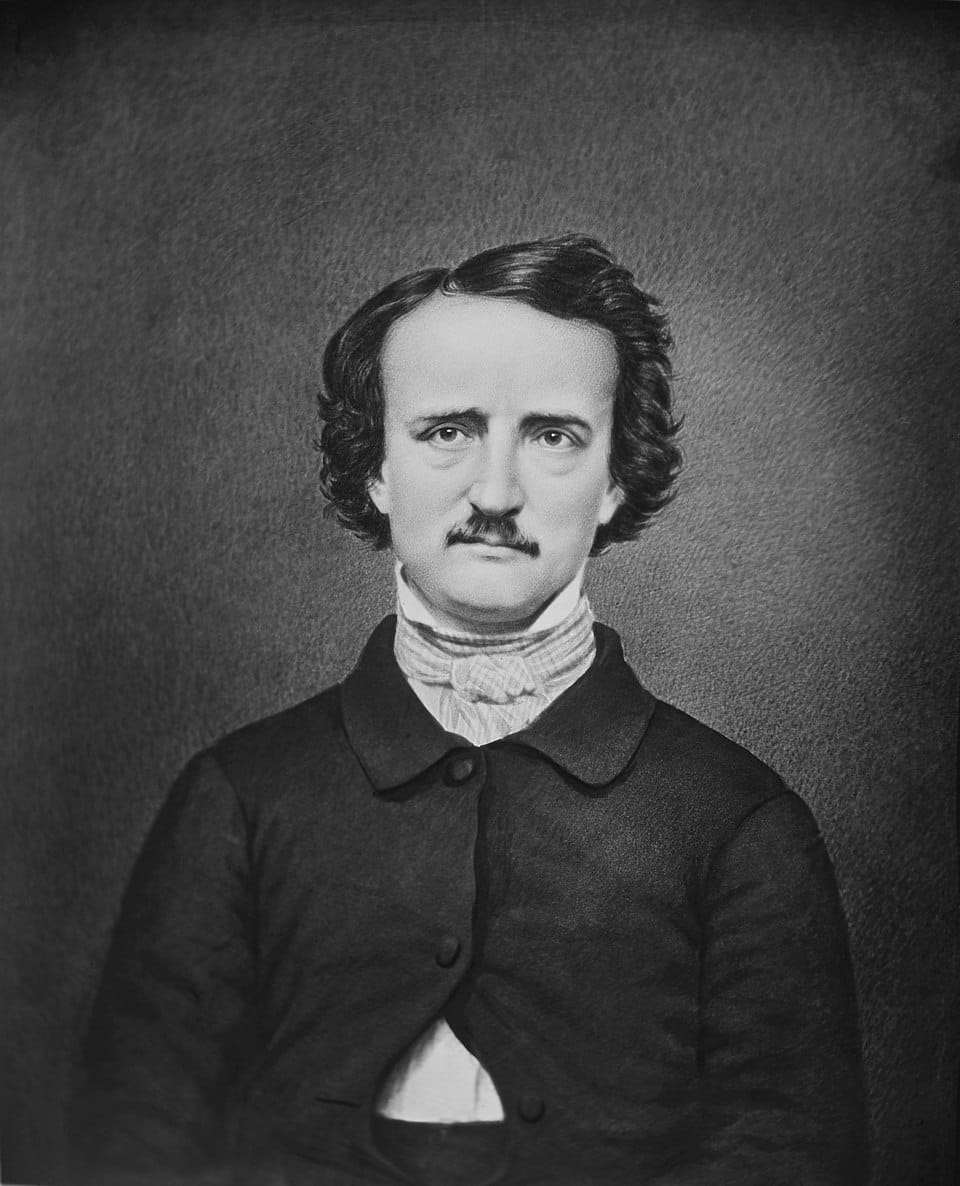
Edgar Allan Poe
1809-1849
Edgar Allan Poe is perhaps one of the most famous American poets to have written. He possessed a firm control over rhythm and sound, writing some of the most unique and identifiable verse in all of English poetry. Anyone picking up The Raven or Annabel Lee will be instantly impressed with its music. In an age of mass confusion about what actually makes a poem a poem, his writings are some of the best examples to use when showing what poetry can do.
Poe had what appears to be somewhat of a sad life himself, filled with loss and disappointment. His writings, no wonder, carry much of this ethos, centering broadly on sadness, terror, longing, and mysticism. His unique style of poetry often contains a heavy use of refrains, or lines/phrases that are repeated regularly. Quoth the Raven "Nevermore", and so on. You'll find that, in doing so, many of his lines end in the same words—a typical faux pas in rhyming poetry, but done surprisingly well in his verse. It works almost to the same effect as a lullaby for children: a rhythmic going out and returning, lulling us not into sleep but into sadness.
Ulalume
I tried to not choose this poem to share (since I've shared it before)... I really did. But I couldn't keep myself away from it! If The Raven and Annabel Lee are his most well-known successes, Ulalume is his secret masterpiece, the one (at least to me) that has had the most emotional impact. Reading this poem tricks you in a way, almost the same way that music can: it makes you feel without understanding. You can't fully explain every detail of this poem, nor work out all its symbolism; but you can feel it and weep with him at the vault of Ulalume.
His rhythm here is one of his bests, utilizing the anapestic foot (like in Annabel Lee) with feminine rhymes (lines ending with an unstressed syllable: sober). His repetition is dialed up to the max, with a steady recurrence of phrases in each stanza. The ending return of
Then my heart it grew ashen and sober
As the leaves that were crispèd and sere—
As the leaves that were withering and sere,
is devastating, and by far the most emotion I've felt in a Poe poem.
(It's worth noting that I typically don't like including the final stanza in reading. The first time I read the poem the final stanza was omitted, a decision that one of Poe's editors made when publishing it. Many anthologies still do not include the last stanza. It's likely bias on my part based on my first reading, but the final stanza doesn't seem to fit or flow as well with the rest of the poem. Apparently Poe was himself confused by his own ending.)
Lenore
Here is another poem on the loss of a beautiful young woman, the same as the one named in The Raven. It is written in iambic heptameter (7 feet), which often flows to the same pattern as a ballad verse. Each line naturally groups into a 4-3 split, and he often internally rhymes the ends of these 4 foot sections with each other. It's ending almost has an upward swing, with her soul in the bliss of Heaven. But there is still the sense of loss, of the fact that we must remain in this lower plane, away from the beautiful.
Further Reading
- To My Mother - Here's a tender poem that Poe wrote to his mother-in-law.
- To Helen - A classic love poem praising the beauty of a woman
- Song - Another positive, love poem for his wife
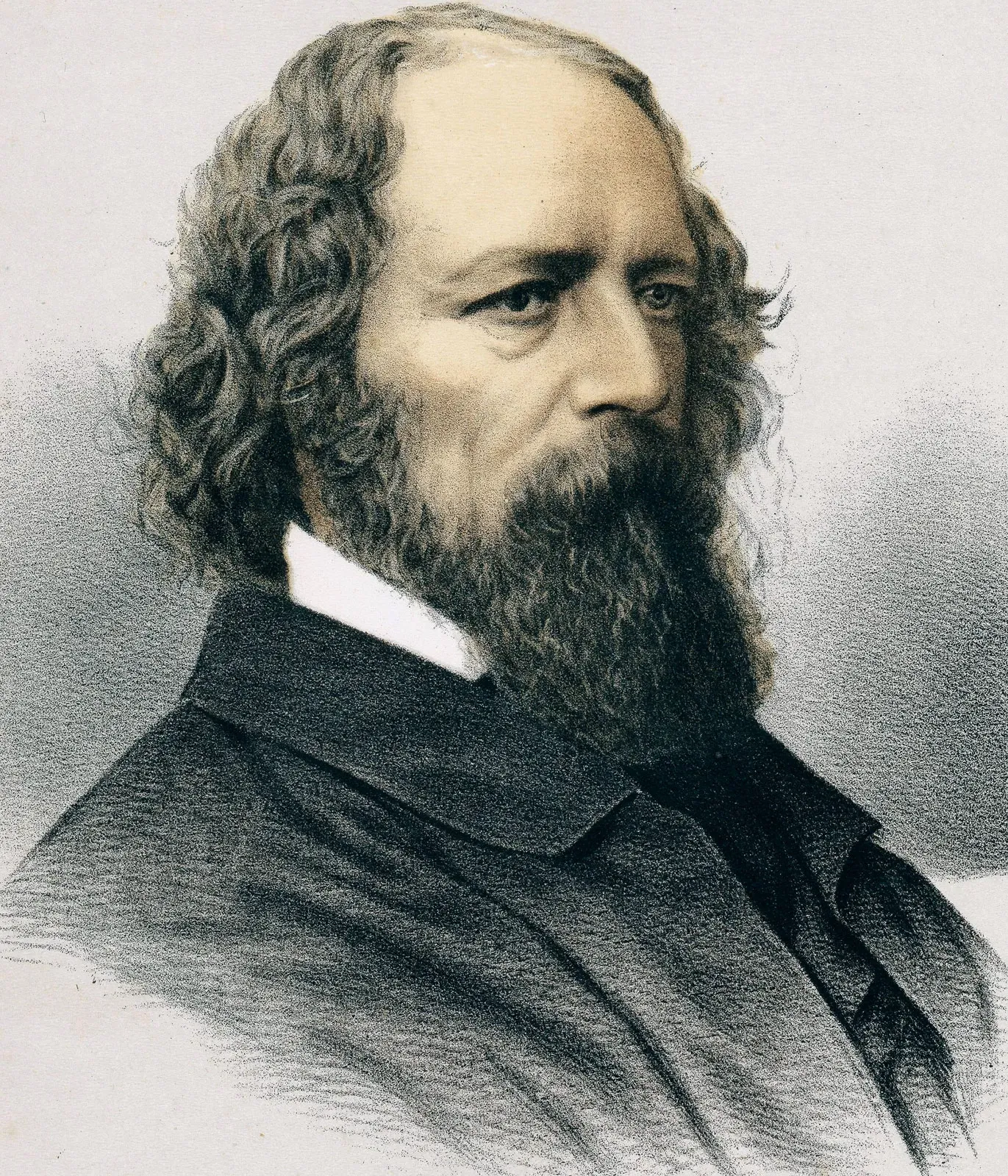
Alfred, Lord Tennyson
1809-1892
Alfred Tennyson, to parallel Poe, is one of the famous and established poets of the English Victorian era. He was the Poet Laureate of the kingdom for a large portion of his life, from 1850 unto his death. He wrote a wide range of poetry, from longer works of memorial and legend to shorter lyrics and poems. He is characterized by a very musical and sonorous style, delightful to read aloud by all ages. He is not as dismal as Poe, but his verse does contain sadness where appropriate, joy in the beautiful, and honor in the heroic.
Mariana
This poem was published in Tennyson's first collection of poetry in 1830. It depicts a sad picture of a woman wishing for a man to return. There is no clear resolution by the end; all you find is full imagery and descriptions of the house and surroundings, all supporting the theme of longing and loneliness. Such lines as these display Tennyson's musicality:
Weeded and worn the ancient thatch
Upon the lonely moated grange.
She only said...
Each stanza has 12 lines of iambic tetrameter, rhyming in groups of four lines with an ABAB pattern. The final 4 lines have shortened B lines, making it behave like a ballad stanza form (4-3-4-3).
Break, Break, Break
Here is a great example of Tennyson's short lyric. It features the sea (a frequent Tennyson image) and a feeling that the sea so often embodies: a longing for someone. The "break" words almost have an onomatopoeic impact on you as you read them, the hard "k" sounds allowing you to hear the sea crashing against the rocks. The line "Break, break, break," is only three syllables, but it feels longer than the rest of the lines. This is because all three syllables are stressed, so you are forced to paused between each of them. The meter in a Tennyson poem may not always be rigidly metered, but it is all exactly done to the purposes of his design.
Further Reading
- Tears, Idle Tears - A standalone song from longer poem called The Princess.
- The Charge of the Light Brigade - A poem written as tribute to the charge of an English cavalry in the Crimean War.
- Sweet and Low - Another song from The Princess and one of my personal favorites.
Home
Abram Newcomer
This sonnet was written to my wife after our first year of marriage. We would always (and often still do) greet each other with a whistle when entering the house. This line has ever since stuck out to me as one of my favorites:
...the foam
Of seas may please to calm—her hands belong
To sweeter ease...
Thank you for reading this week's edition! I hope you enjoyed these poems.
Discussion