



Your weekly slice of Historical Poetry
> Thomas Traherne
> Jonathan Swift
> Alexander Pope
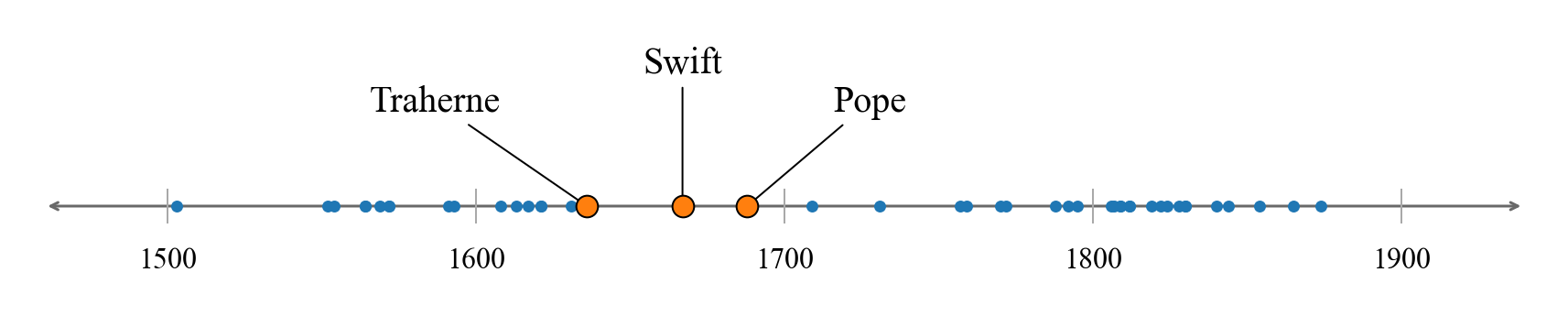
Welcome back to the ninth part of the Poet's of History series! While we will continue to dive into the Neoclassical period, we will get to have one last encounter with a metaphysical poet. I hope you enjoy!
Thomas Traherne
1636-1674
Thomas Traherne was an Anglican priest and poet. He was not very well known at the time of his life, his work only being found and published near the beginning of the 20th century. (I couldn't even find a portrait of him.) Traherne's style is decidedly in line with the other metaphysical poets, though it is still very unique in its voicing. His poems seem slightly more mysterious, their themes often being less obvious than they would be for, say, a Herbert or Donne poem.
News
This poem has taken me quite a number of reads to digest, and I still don't think that I've understood all of it. It starts with a man eagerly awaiting news from a distant land, from which all his treasure and delight appears to be found. It ends with an infant close at hand, whose true worth is beyond the value of the entire world. It is to be read and pondered for a while.
In terms of form, it is written in an interesting meter with varying line lengths. Every stanza contains lines with the following lengths: 4545323423443.
Further Reading
- Eden - This poem (along with the one below) depicts the poet's innocence as that of Eden before the Fall.
- Innocence - Beautiful, if only for the final line: "I must become a child again."
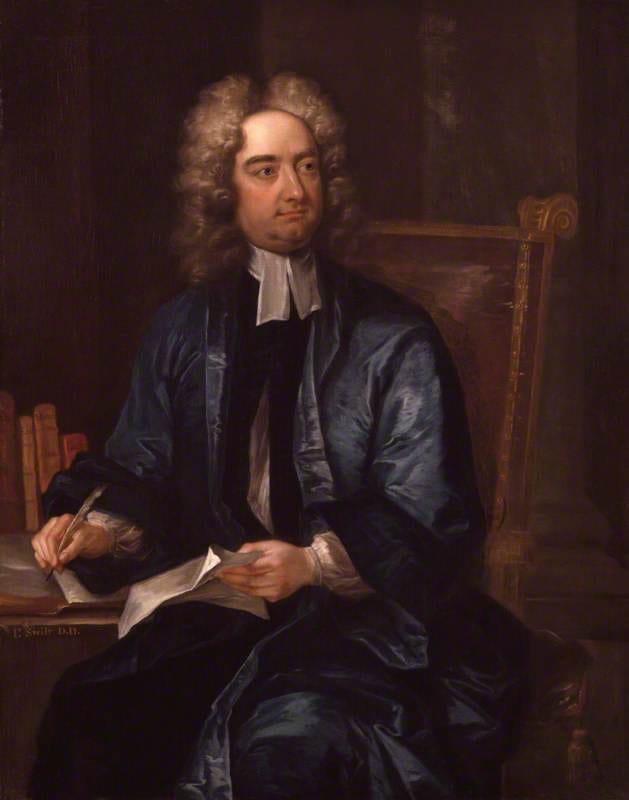
Jonathan Swift
1667-1745
Jonathan Swift was an Anglican cleric and author who specialized in satirical writing. He wrote Gulliver's Travels, along with other satirical works and poems. His poetic style is not very heady, but is more witty, humorous, and even crude at times.
A Description of a City Shower
This is a great example of Swift's lighter and comical style. Much of the city-life is poked fun at in this poem, such as the descriptions how different groups respond to the sudden rain.
Triumphant Tories and desponding Whigs
Forget their feuds, and join to save their wigs.
It is written in iambic pentameter, rhymed in couplets.
Further Reading
- A Description of the Morning - As the title suggests, this is a smaller descriptive poem allowing us to see the world through Swift's witty eyes.
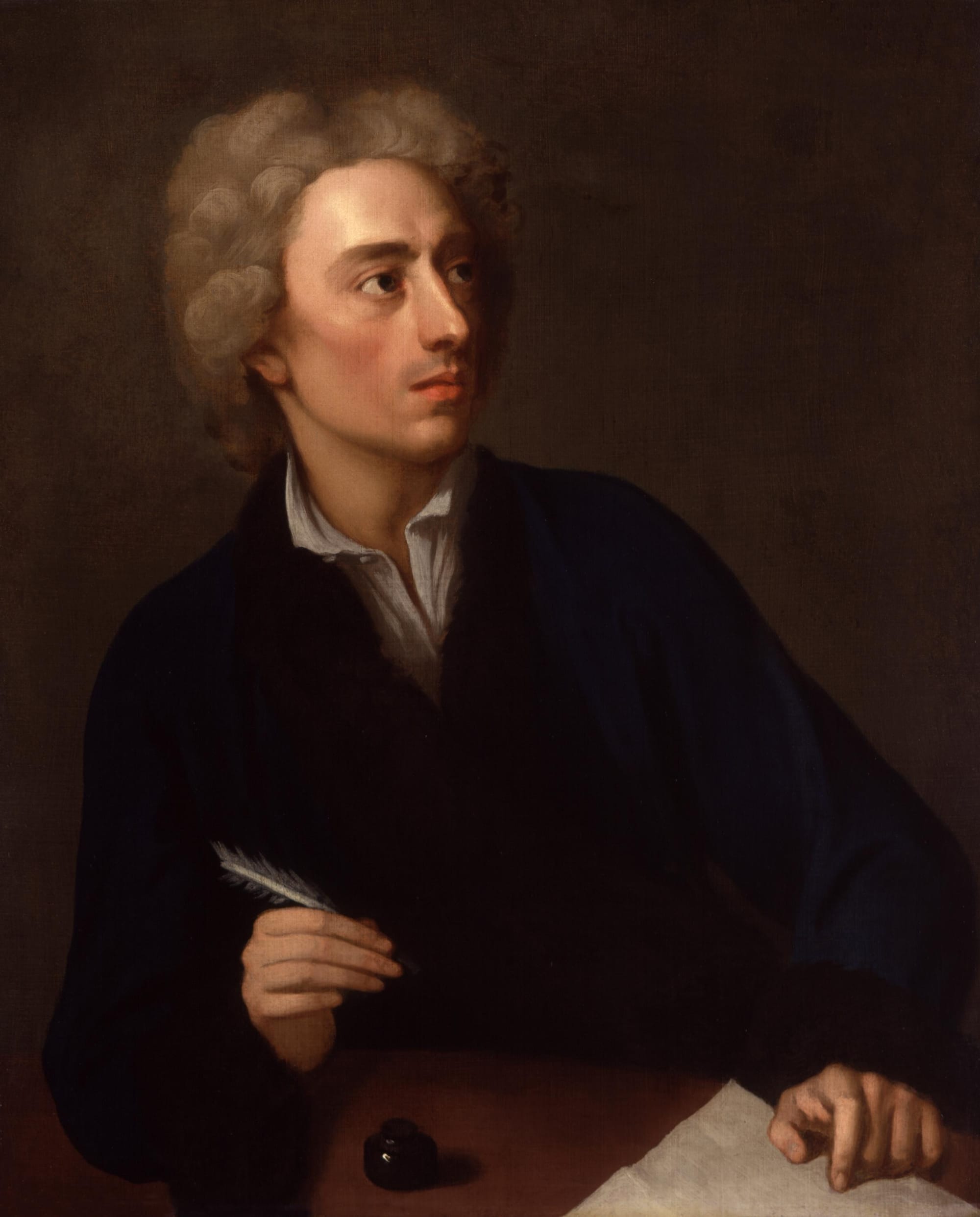
Alexander Pope
1688-1744
Alexander Pope is likely to be considered the greatest of the Neoclassical poets. He, like Swift, was a master of satire and wit. He showed himself to be something of a genius in his youth, publishing his long-standing poem The Essay on Criticism when he was only 23 (with ample good poetry before this as well). He was extremely skilled in condensing thoughts down into their most subtle and clear phrasing. Often, some of his lines or couplets have been taken on their own, almost as proverbs or common sayings. It's always fun to see which phrases come from him, such as the following.
- "Fools rush in where angels fear to tread" (Essay on Criticism)
- "Hope springs eternal in the human breast" (Essay on Man)
- "A little learning is a dangerous thing" (see below)
Pope championed and perfected the "heroic couplet" form, in which iambic pentameter lines are both rhymed in couplets and end-stopped (some punctuation or pause at the end of each line; no enjambment). He wrote multiple larger poems in this form, such as the aforementioned Essay on Criticism, the Essay on Man, The Rape of the Lock, and his translations of Homer's Iliad and Odyssey.
A Little Learning
This is excerpt from The Essay on Criticism, in which Pope warns against the temptation to only learn surface truths and never dive any deeper. The famous first line is a wonderful example of the proverb-like quality of Pope's wit: he crafts a line that is so clear that it is immediately understood and agreed with. The rest of this section is an expansion on this idea, but all you really need to remember is that first line. This truth is even more applicable today in which it is easy to know a little about everything, but harder to commit to one thing and study it to its depths.
The Universal Prayer
Though he is known for his iambic pentameter, Pope unsurprisingly shows his skill at writing in other meters, such as this prayer in ballad verse (stanzas of 4-3-4-3 length). You'll note that even though this poem is explicitly Christian, it reads much differently from a poem by a metaphysical poet. The thought and expression is very clear and orderly; there are no stretched out metaphors or surprising images. This is a prayer that you can actually pray and understand what you are saying on the first read through.
Further Reading
- The Dying Christian to his Soul
- On a certain Lady at Court - Another example of Pope's wit and humor.
Cleave
Abram Newcomer
Here is the third Sal that I've ever written, published back in April of this year. When writing a poem with hard constraints, you discover quickly how difficult it is to condense a thought down into a short line of poetry. You inevitably leave out something you would like to say, unless you happen to strike on that perfect phrase that fits your meter, rhyme, and sense. For this poem, I was delighted to stumble upon the word "Awake", which appears in one of the central lines. I found that it was a perfect fit to tie in the theme of Adam sleeping while Eve was being made. It's amazing how just one word or one line of poetry can do so much for a poem.
Thank you for reading!
Discussion