



Your weekly slice of Historical Poetry
> George Herbert
> John Milton
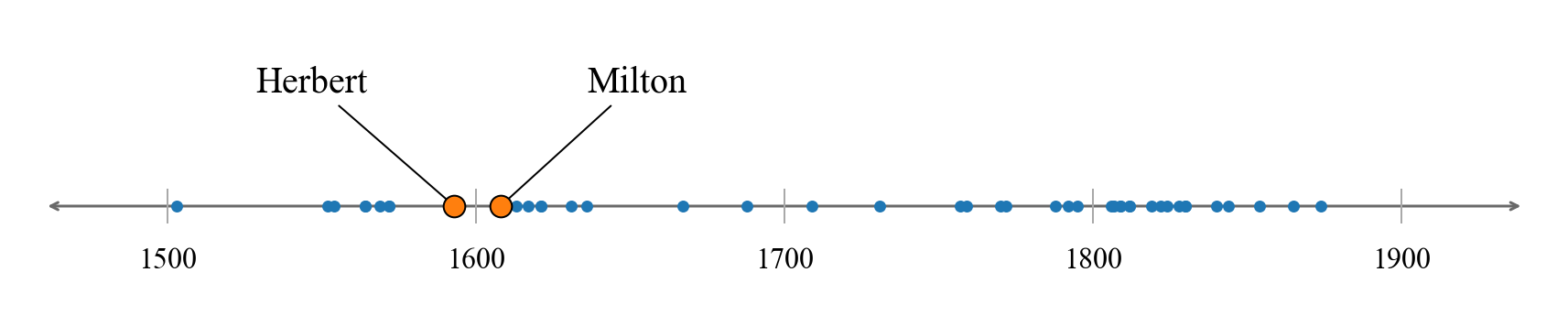
This week offers, yet again, two strong figures of English poetry. As before, we are continuing to see the influence of previous poets on the ones that we are currently discussing. As an example of this, both of these poets were influenced in some ways by John Donne, whom we covered in the last edition.
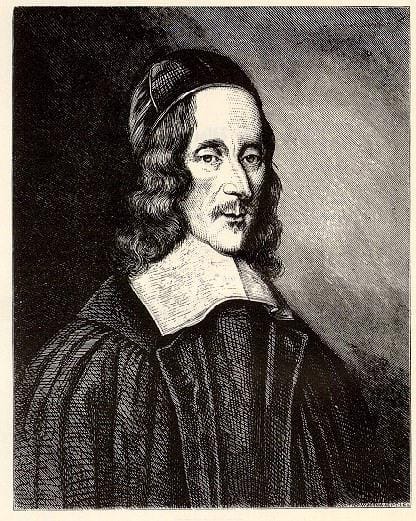
George Herbert
1593-1633
George Herbert was an English poet and, later in his life, a priest of the Church of England. He is frequently listed as a member of the "metaphysical poets," who (just as we discussed with John Donne) are characterized by using very strong and unusual metaphors in their poetry. He was known to be a devoted and caring priest, dying at the age of 39 due to an illness.
Herbert wrote mostly religious and devotional poems, each brimming with Biblical imagery and true expression of the heart. Sin, redemption, despair, joy – all ranges of the Christian experience can be found in his words. There is rarely any triteness to be found, nor sentimentality. His poems are still meaningful today because of his beautiful capturing of real Christian living. My blog is named after his line in this poem after all, and, unsurprisingly, he is the most shared poet in my Poetry Pie series.
The Altar
This visual, devotional poem could be considered a good summary of Herbert's work and devotion to Christ. He erects an altar to God, made directly with his own heart and formed by divine hands. His heart, though hard as stone, can only be cut by God's power (altars had to be built with "uncut" stones, something only "cut" by God). Yet, an empty altar means nothing, and so it is "thy blessed sacrifice" that is placed upon it, to sanctify the whole structure. There is so much here that could be further explored and studied.
A visual poem is one where the words are arranged on the page to present some pictorial representation of the poem. He does this by changing the length of the lines from the edges toward the center: it starts/ends as pentameter (5 feet), then moves to tetrameter (4), then centers out with dimeter (2). He has done something like this in other places, notably in Easter Wings and Aaron. And even when not doing it for visual reasons, Herbert will often write with changing lengths of lines, resulting in unique rhythms.
The Agony
While a devotional poem will address God directly (much like a prayer), this poem simply expounds on an idea to the reader. Herbert presents two things which cannot be fully fathomed: sin and love. He addresses these in the second and third stanzas respectively, but notice how he uses the same event to describe both: the cross. Only at the cross do we see how horrifying sin is in addition to how great is God's love. He finishes the poem with a masterful turn, in which he shows how the blood and agony of Christ becomes the sweet wine of communion for his people.
Love in that liquor sweet and most divine,
Which my God feels as bloud; but I, as wine.
Further Reading
- Virtue - A great example of a "metaphysical" poem, in which various, strong metaphors are used to describe a spiritual truth.
- The Pulley - A unique description of when God was creating man.
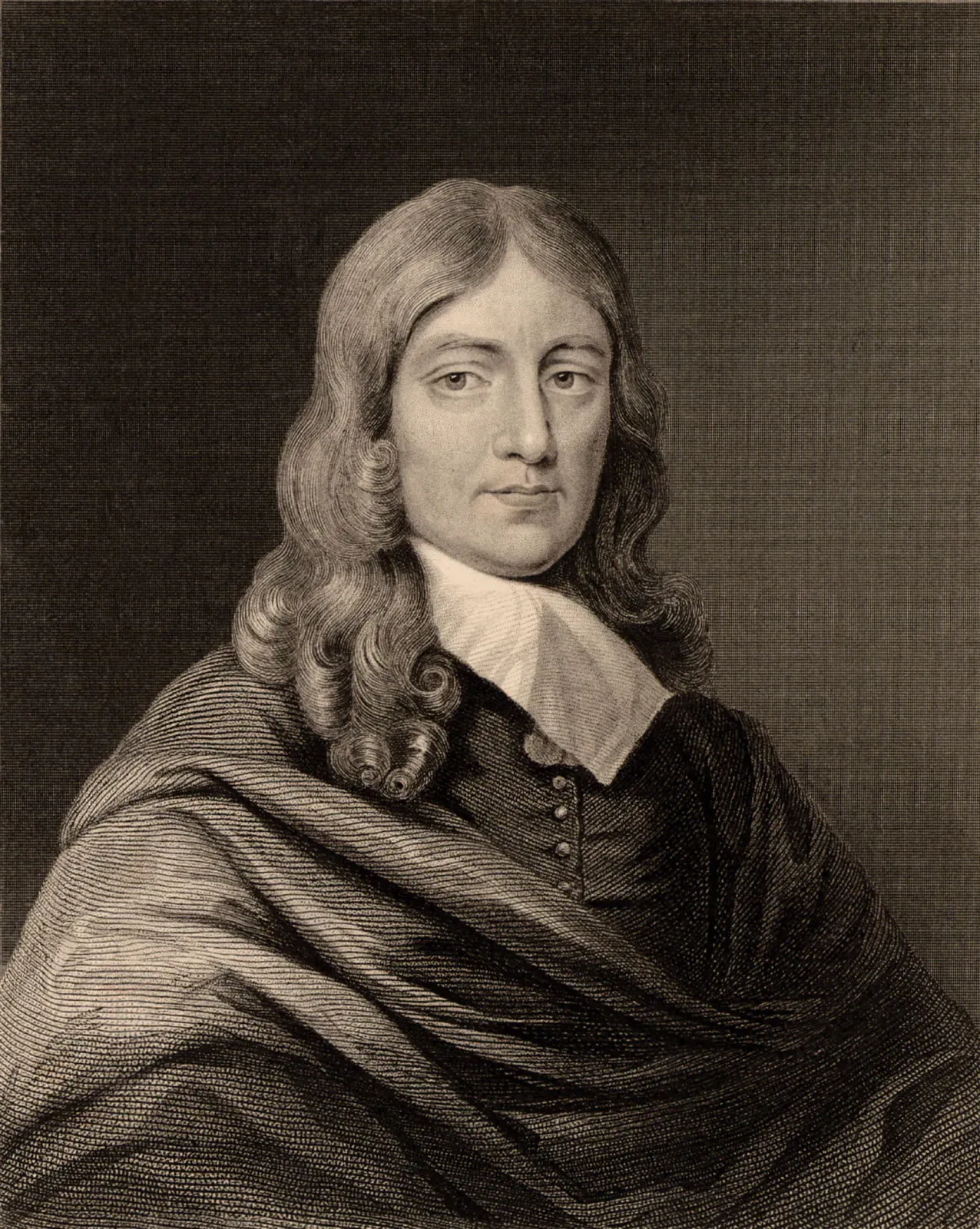
John Milton
1608-1674
John Milton is considered to be one of the greatest English poets to have written. He is best known for writing Paradise Lost, an epic poem in Blank Verse retelling Creation, the fall of Satan, and the fall of man. While Dante's Divine Comedy stands as a triumph of Roman Catholic theology, Paradise Lost is one of the jewels of Protestantism. Besides this work (which he completed later in his life), Milton wrote other poetry, including sonnets, elegies, and many more. His poetry feels similar to that of Edmund Spenser, being full of classical characters, Greek gods, and Scripture.
At a Solemn Music
This poem depicts the glorious music spun by the angels and saints around the throne of God in Heaven. It begins by calling on the two Sirens, Voice and Verse, to join together and to bring dead things to life. Good music rises to heights often higher than poetry, simply because it involves poetry itself, illuminated further by tones, sounds, and chords. Milton's father was a musician, and there would be no doubt that music was highly important in his life. The poem ends with a hope and prayer that Heaven's music would echo down to earth and revive the old song that Creation sang to God before the Fall.
This poem contains mostly iambic pentameter lines, though some are shortened to trimeter and tetrameter, and the last line lengthened to hexameter. The rhyming is somewhat irregular, though it mostly consists of couplets (two successive rhyming lines).
On His Deceased Wife
Here is one of Milton's sonnets, depicting a vision he has of his late wife. Milton had three wives in his lifetime, the first two each dying by complications in childbirth. This sonnet was likely written concerning his second wife, whom he married in 1656. What's interesting is that it appears that Milton had already gone blind by this point; he may have never seen his second wife with full clarity. Yet in this vision he can see her and recognize her clearly. Reading the poem again, notice how much of the imagery revolves around sight. Knowing this makes the ending line even more tragic:
I wak'd, she fled, and day brought back my night.
Further Reading
- When I consider how my light is spent – His always-anthologized poem, discussing some aspects of his blindness.
- Paradise Lost Book 1 Lines 482-489 – The first part of Paradise Lost contains descriptions of Satan falling, along with all of his angels. The angels are named as some of the pagan gods of the Old Testament. In this part of the book, the gods of the Egyptians are discussed who were in the shape of oxen and calves, the worship of whom Israel itself would fall into. Lines 488 and 489 were especially exciting to me when I read them.
Pray for Poets
Abram Newcomer
My most recent poem is likely to be an odd flavor to taste after what has already been shared in this newsletter. Regardless, I'm pleased to share it again being one of my most recent favorites. I had the idea a few weeks ago and worked on it in what could possibly be the most pleasant setting: in the woods surrounded by the cloudy aroma of my pipe. We poets tend to take ourselves quite seriously, and I hope this poem digs at that a little (all while acknowledging the importance of poetry).
As always, thank you for joining me on this walk through history. I hope the discussion has been beneficial. Take care!
Discussion