



Your weekly slice of Historical Poetry
> Henry Vaughan
> John Dryden
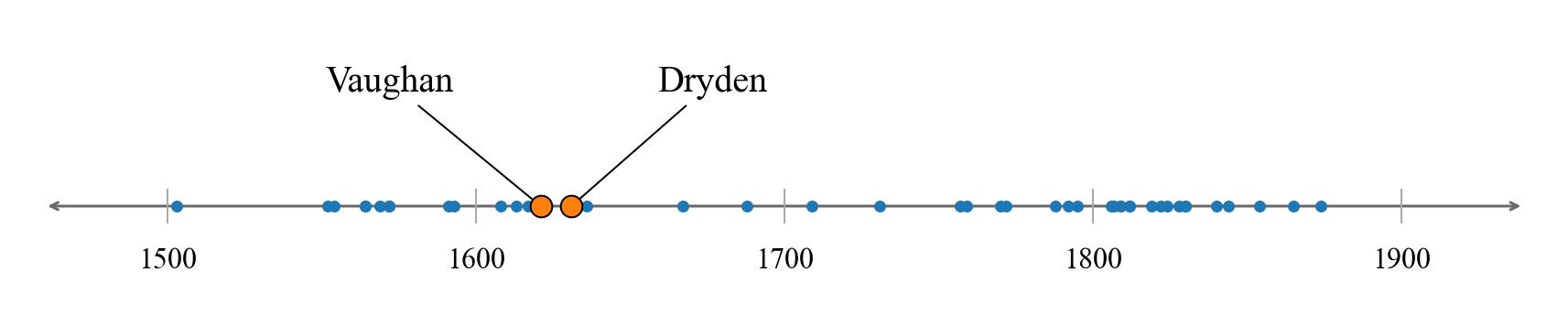
This week of the Poets of History features two authors on the edge of two distinct eras of poetry. One poet will mark the end of the metaphysical poets, which we have seen much of these past few weeks. The other will mark the beginning of a new age of poetry and art: Neoclassicism, the period that will extend until the end of the 18th century.
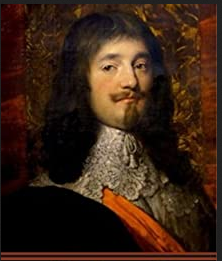
Henry Vaughan
1621-1695
Henry Vaughan was a Welsh doctor and poet, potentially one of the last to be considered in the "metaphysical" line of poets. He had something of a conversion experience in the middle of his life, in which he turned from from secular ("vain") poetry and devoted himself to writing Christian verse. He was (like many other poets in that generation) heavily influenced by George Herbert, which we will be able to see in some of his poems below. Some accuse him of being too derivative of Herbert, though he does clearly have a distinct voice compared with the famous poet.
The Retreat
This poem expresses a longing for the innocence of youth, specifically a youth that had yet to be corrupted by sin. He describes how he would see the world as rich with the presence of God, with a head brimming with "celestial thought[s]." He describes his goal not as moving forward in a progressive mindset, but rather moving backward (a "retreat") toward innocence. You should be able to see the influence of Herbert here. The poem is similar to many of his in how it has a unified theme around a desire for purity, innocence, and a dissatisfaction with the vanity of the world.
The poem is written in iambic tetrameter, with couplet rhymes. He has healthy amounts of alliteration in the poem, though he does it not-so-obvious ways. Note the following lines, where the "s" sound is subtly carried throughout it, along with the short "e" sounds toward the end.
Before I taught my tongue to wound
My conscience with a sinful sound,
Or had the black art to dispense
A several sin to every sense,
But felt through all this fleshly dress
Bright shoots of everlastingness.
The Water-fall
This poem is certainly metaphysical in character. It uses a feature of the world, a waterfall, and finds a deep spiritual truth within it with a unexpected metaphor. The waterfall flows in an almost circular manner: the water which passes through it will one day return to its source. This mirrors how we are sent forth from our Source, God, and yet we will return to him.
Yet this poem differs from Herbert's style, especially in the fascinating first stanza. The first few lines (especially the first) are quite amazing in its construction and sound.
With what deep murmurs through time’s silent stealth
Doth thy transparent, cool, and wat’ry wealth
Here flowing fall...
I'd be surprised to see these lines in any of Herbert's poetry. The line variance is unique as well in the first stanza; lines modulate from pentameter (5 feet) to dimeter (2). The second and third stanzas, however, converge into tetrameter lines in a more regular fashion. Regardless, while Vaughan may have inherited a lot from Herbert, there is true innovation and personality in his poems that is worth discovering.
Further Reading
- Peace - Another poem with a call or longing to be united to God.
- They are all Gone into the World of Light - A somber poem that is very often anthologized.
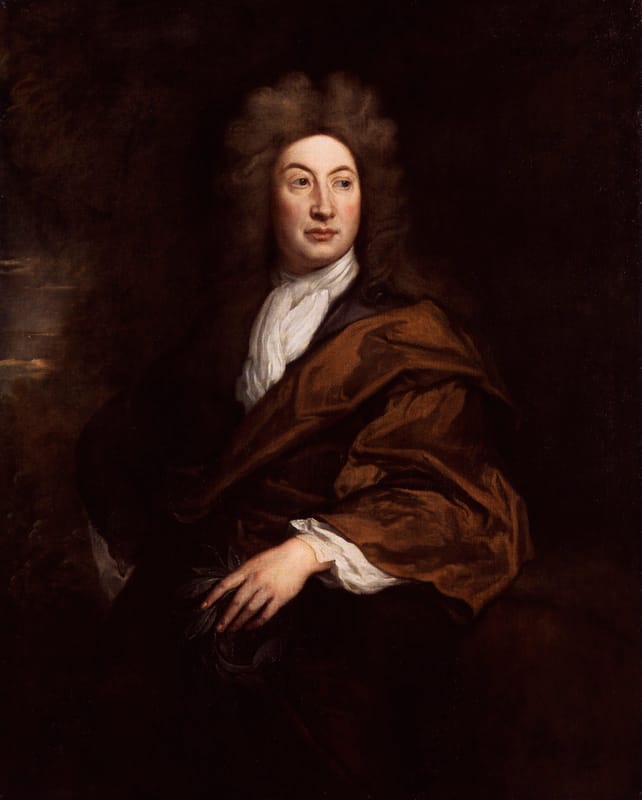
John Dryden
1631-1700
John Dryden was an English playwright, satirist, and poet. He was the first to ever be chosen as Poet Laureate of England, appointed by King Charles II in the Restoration Period. He is also considered to be the first poet leading into the Neoclassical era, which was characterized by Enlightenment ideals, reason, and so forth. As such, you will see how his style (and those of poets to come) will differ from the metaphysical poets that we've been studying. The poetry feels more intellectual and rigid, less likely to employ the elaborate metaphors and conceits that characterized the metaphysical poets.
Dryden helped to set some of the tone of this type of poetry. He established the heroic couplet form: lines of iambic pentameter that end-stopped (each line ends with a punctuation, pause, or period) and are rhymed in couplets. This form would be used strongly in the Neoclassical period, especially by Alexander Pope, whom we will study in the next edition.
A Song for St. Cecilia's Day
St. Cecilia is the patron saint of music, and so this poem features a broad discussion and enjoyment of the thrills of music. The first stanza describes the creation of the world, in which all the atoms form together in response to music from above, the "Heav'nly harmony." Each successive stanza continues the elaboration on the power of music, focusing briefly on Jubal (Gen. 4:21) and on various instruments. It is a fitting poem for the celebration of music.
It is written in iambic meter, with lines ranging in length quite a bit, from pentameter all the way to dimeter. The rhyme scheme is different for almost every stanza, allowing for a flowing structure that you aren't necessarily aware of as you read. The second stanza stands out with the use of the repeated "ell" rhymes. Overall, this is a very sonorous and delightful poem!
Veni, Creator Spiritus
This beautiful poem is written as a prayer to the Holy Spirit, one that we all could pray in our own devotions. It gives him praise for what he is and what he does, asking him to come and sanctify our hearts, to reveal more of the triune Godhead to us. It is written in iambic tetrameter and is rhymed in couplets.
Further Reading
- Ah, how sweet it is to love! - A good-hearted love poem, describing the joys of being in love.
- Song to a Fair Young Lady Going out of Town in the Spring - A poem bemoaning the absence of Chloris, whose presence brings Spring and life itself.
Fence Digging
Abram Newcomer
This poem was written two weeks ago and was published a week ago. It features the fence that my father and I had recently finished installing, along with a little meditation and thought. I've enjoyed this as a more "down-to-earth" poem, having common images and language that is (hopefully) easy to follow. As my own philosophy of writing is developing, I'm finding that clarity is becoming an important requirement. Poetry, above all things, must be clear. Poems that are opaque are frustrating to readers, especially those that aren't poets or poetry enthusiasts themselves. We need more common, well written verse that can withstand the skepticism and "but why?"s of the modern world. Whether this poem achieves this or not, this is slowly becoming one of my focuses as a poet.
I hope you enjoyed this exposure and discussion. Until next time, keep reading poetry!
Discussion