



Your weekly slice of Historical Poetry
> Geoffrey Chaucer
> Sir Thomas Wyatt
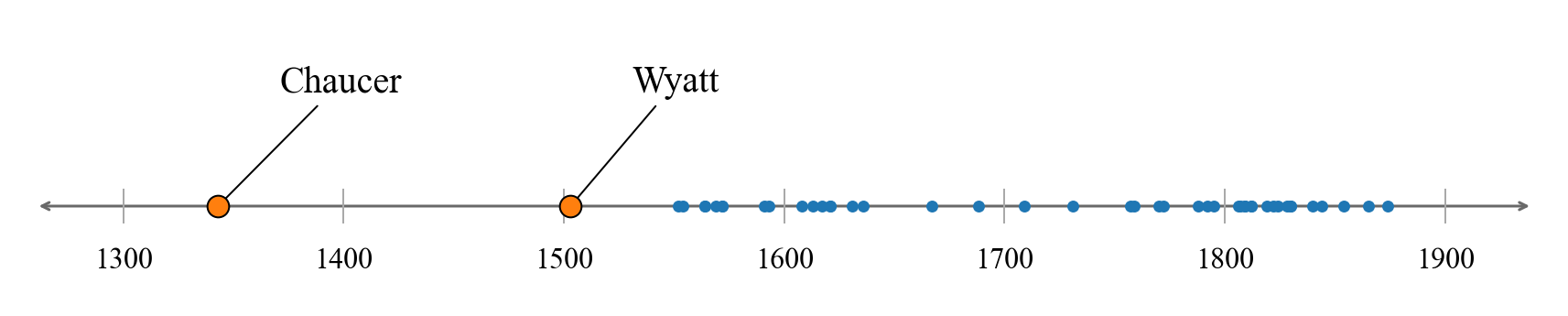
Welcome to the very first edition of Poetry Pie: The Poets of History!
We are starting almost 700 years ago when English poetry was just beginning to take on a life of its own. English itself was still evolving, at the stage that we now call Middle English. This form is just at the horizon of what we modern readers can likely understand (with a little patience). From there, we jump forward to the birth of the sonnet (in English) and near to the beginning of the great poetic tradition that we have been blessed to inherit.
As is inevitable, there is much other English poetry in these times that is missed. Yet I hope that reading Chaucer and Wyatt will give us a good taste of where our poetry has come from.
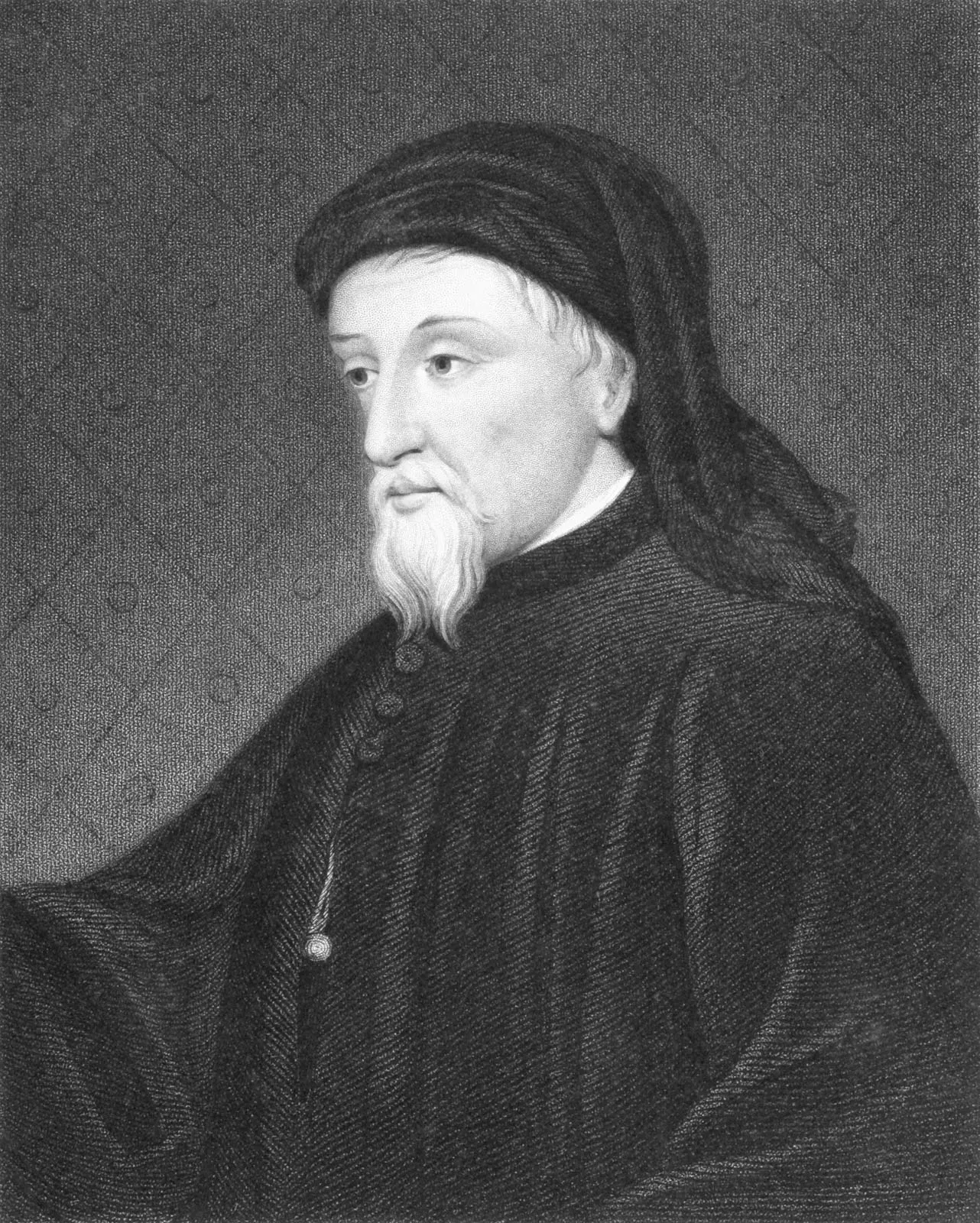
Geoffrey Chaucer
~1340-1400
Geoffrey Chaucer is considered by many to be the "father of English poetry." His most well-known work is The Canterbury Tales, which is written entirely in Middle English verse. In many ways, he was one of the first to create poetry with the English language of his day, leading to the development of English poetry as a whole. In his poems, you will find many of the tropes and patterns that would come to characterize much of English poetry in the centuries to come, such as the extravagance of a woman's beauty, the pain of her rejection, the metaphorical use of nature, and the expression of Christian devotion.
As a note for reading Middle English with all its strange spelling, I would suggest reading it out loud. While I am no expert on English linguistics, hearing the sound of the word will often help you to know what he is saying. For example (from the first poem below):
...that passeth sone as floures fayre
Read it out loud and you can discern this probably as
..that passeth soon as flowers fair
This will take a little patience on your end, but it is well worth it. I would further recommend that you don't get caught up on any words that you can't understand. Keep trucking through the poem and try to decipher it on the next round through. If you're at a complete loss on a word, you can also use this online ME dictionary resource.
The Love Unfeigned
This poem is addressed to "young folks" as an admonition to see where true love is found. The first stanza encourages the reader to be mindful of the love that is growing up in them that can be so fleeting in a vain world. This is contrasted with the love of Christ, who
the which that right for love
Upon a [cross], our soules for to [buy]
First [died], and [rose], and sit in hevene a-bove;
In terms of form, note that it is written in iambic pentameter, a form that would come to dominate English poetry. Each stanza is an septet (7 lines) and is rhymed ABABBCC. This form was created by Chaucer himself and is known as the Rhyme royal.
Merciles Beaute
(The link above contains the first roundel in modernized English, with the rest of the original text below.)
Merciles Beaute ("merciless beauty") is a set of three roundels concerning the dangerous beauty of a woman. Such praise (a defining staple of the romantic poem) is coupled with the plea for the woman to not further the damage by rejecting him.
A roundel is a form containing three stanzas: a tercet rhymed (ABB), a quatrain rhymed (abAB), and then a sestet rhymed (abbABB). An additional defining feature is the repetition of 3 lines or refrains, noted by the capitalized A and B letters in the previous sentence. It is also written in iambic pentameter. This form is similar to but not to be confused with the rondel, the rondeaux, and the triolet.
Further Reading
- A St. Valentine Rondel - A fitting poem for Valentine's Day coming up!
- Balade - Another poem praising the beauty of a woman, to the shame of all the great beauties of history
- The Canterbury Tales: General Prologue - You can read the whole prologue here in its original construction. By a quick Google search you can also find many free editions of this entire work, both in Middle English and in a modern rendition. I may take up this tale soon!
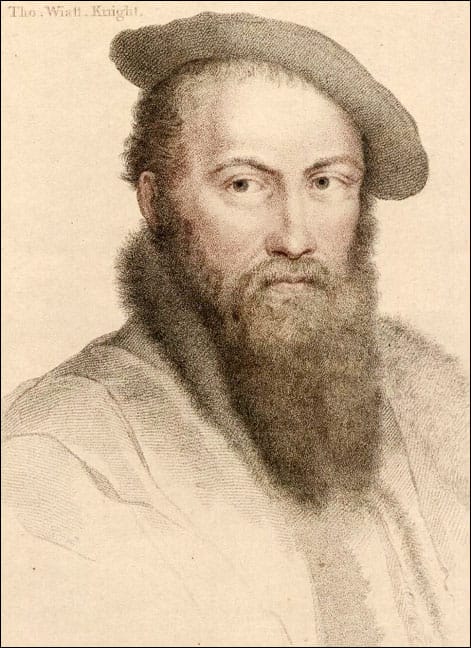
Sir Thomas Wyatt
1503-1542
Sir Thomas Wyatt was a poet and politician in the courts of King Henry VIII. He is best known for introducing multiple poetic forms into English, of which the sonnet is the most notable. He brought the Italian sonnet over to English by translating many of Petrarch's examples, along with producing many of his own.
His sonnets are considered to the first sonnets ever written in English. He even developed them such that they contain a final rhyming couplet, something a Petrarchan sonnet did not do. This development would become characteristic of the Shakespearean sonnet, who perfected this dramatic ending. Wyatt's contributions can not be understated to those who realize the place that the sonnet holds in English poetry.
Whoso List to Hunt
This is one of his most famous sonnets, representing the angst of loving the unattainable woman. He skillfully shrouds this theme with the metaphor of a wild deer belonging to the king, one which cannot be hunted by the order of the crown. She is marked clearly with Noli me tangere ("touch me not"), for she belongs to "Caesar." It has been rumored that this poem could be referring to an unconfirmed relationship that he had with Anne Boleyn, the fateful wife of King Henry VIII.
Forget not Yet the Tried Intent
This poem is a plea of a man to the object of his love, that she would remember his love and the history of their relationship. It is written in iambic tetrameter with quatrain stanzas. The first three lines of each stanza rhyme with each other, increasing the tension that is only resolved with the final line: "Forget not yet." This sort of extended rhyme resolving into a repeated refrain can be seen in many other places, one example being Tennyson's "The Lady of Shalott." (You can even find this extended rhyme in my own poem linked below.)
Further Reading
Winter Awake
Abram Newcomer
As always, here is a poem of my own to round out this edition of Poetry Pie. We still have not yet recovered from the snow storm that just recently blanketed our land. This poem was written to capture some of the joy that I've had hiking through woods that have been lulled to silence with a snowfall.
I attempted a new form for this, something resembling a ballad stanza poem (quatrain stanzas with ABAB lines alternating tetrameter and trimeter). The first and third lines contain regular internal rhyme. I also mixed my meter by using both iambs and anapests. The third stanza contains an extended resolution of the third line, something I quite enjoy in other poems as I find them.
I hope you enjoyed this first edition of The Poets of History. There's more to come! Let me know what you think of this format and I'll see you in the next one.
Discussion